
FISSION PLATFORM
Keep the product together from first build to release.
Build the interface once, run that product on real targets, and carry the same project model through testing, packaging, signing, stores, and hosting. Teams spend their time improving one product instead of coordinating several implementations.
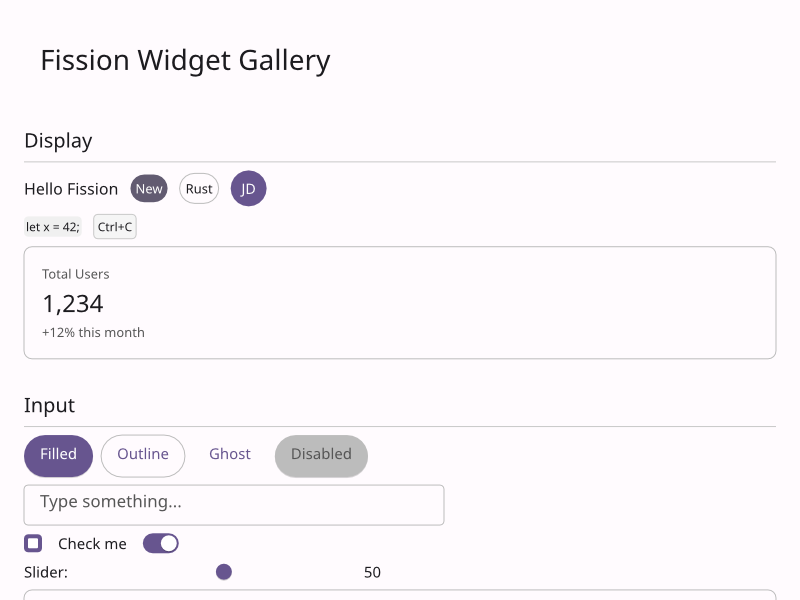
The widget gallery example
PLATFORM SHAPE
One place to make product decisions.
State, interface, platform boundaries, and delivery configuration stay visible in one Rust project, so a change can be reviewed and proven as one coherent piece of work.
RUNTIME
One app model
State, actions, reducers, selectors, widgets, resources, jobs, services, capabilities, and design systems stay in shared Rust.
TARGETS
Every major target
macOS, Windows, Linux, Web, Android, iOS, Terminal, Static site, and SSR targets are treated as product outputs, not side projects.
LIFECYCLE
Tooling after build
Readiness checks, packages, signing, release content, app stores, static hosting, GitHub Releases, rollouts, and receipts are part of the platform.
HOW IT FITS
Share what is product logic. Isolate what is genuinely platform-specific.
Fission shares behavior and interface intent while each shell owns its real operating-system boundary. That keeps reuse honest and platform work explicit.
SHARED RUNTIME
One application shape
A product keeps one model for state, actions, reducers, components, resources, jobs, services, capabilities, and themes. Targets host that model; they do not fork it.
Runtime model
TARGET BREADTH
More than windowed apps
Fission treats macOS, Windows, Linux, Web, Android, iOS, Terminal, Static site, and SSR as first-class targets for the same product architecture.
Targets reference
LIFECYCLE TOOLING
The work after build is covered
The platform story includes readiness checks, packaging, signing, release content, distribution providers, receipts, and CI-friendly automation.
Release docs
LIFECYCLE PATH
From project setup to release receipts.
01
Start
Create a project, understand the app shape, and add the targets you need.
02
Develop
Run on devices, attach logs, use the right shell, and keep product behavior shared.
03
Ship
Check readiness, package, sign, publish, manage tracks, and keep receipts for CI.
One product model
Fission keeps product behavior in shared Rust while shells and tooling handle the host and lifecycle edges.