
CROSS-PLATFORM APPS
Support more platforms without maintaining more versions of your product.
A workflow implemented in shared Rust reaches macOS, Windows, Linux, Web, Android, and iOS. Platform shells still own lifecycle, input, packaging, and other host concerns, so teams share product behavior without pretending every platform is identical.
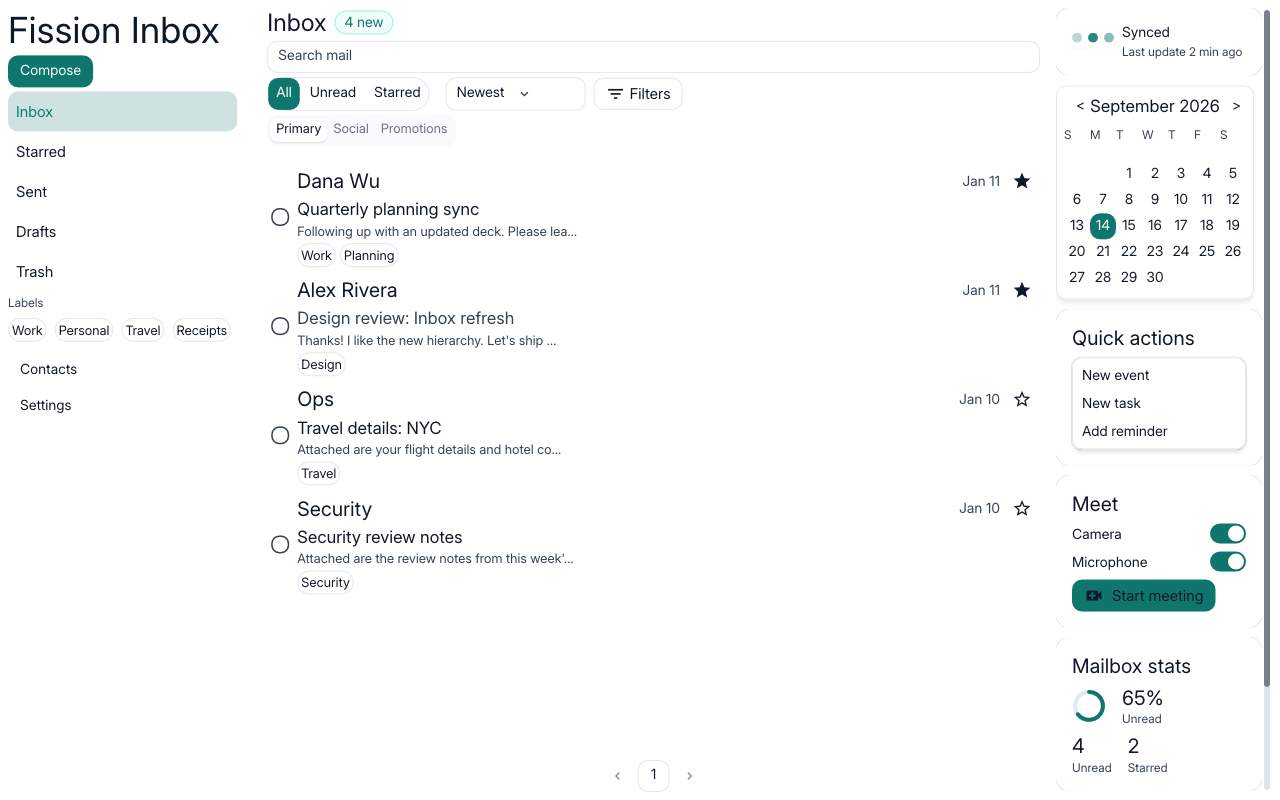
The inbox example on desktop
HOST COVERAGE
Add reach, not another product codebase.
Desktop gives a fast development loop; mobile and Web prove their own input, lifecycle, rendering, and delivery boundaries against the same underlying application.
DESKTOP
Native app loop
macOS, Windows, and Linux provide the fast local loop for product UI, diagnostics, and desktop packaging paths.
MOBILE
Real host projects
Android and iOS hosts keep the shared model intact while validating touch, lifecycle, safe areas, keyboards, package outputs, and stores.
WEB
Browser delivery
The web shell compiles the app for browser delivery without moving product behavior into a separate JavaScript application.
TARGET MODEL
Use the fastest loop, then prove the shipped host.
Work quickly on the most convenient target, then exercise browser, emulator, simulator, device, or desktop packages whenever that platform boundary affects the user experience.
DESKTOP
Use the fastest local host
macOS, Windows, and Linux keep the iteration loop short while still exercising layout, rendering, input, capabilities, and packaging expectations.
Desktop packages
MOBILE
Validate mobile as mobile
Android and iOS runs cover touch input, safe areas, keyboard behavior, app metadata, permissions, icons, launch screens, and store-bound package formats.
Mobile packages
BROWSER
Ship the app to the web
The web target keeps application behavior in Rust while the browser host owns WebAssembly loading, renderer selection, assets, and web-specific diagnostics.
Web packages
RUN LOOP
Move between hosts without rewriting product code.
01
Choose the fastest loop
Use desktop when it answers the current product question fastest.
02
Switch to the host
Use browser, emulator, simulator, or device runs when the host is part of the behavior.
03
Package intentionally
Move from target run to target package without losing the app model.
Real targets
macOS, Windows, Linux, Web, Android, iOS, Terminal, Static site, and SSR are production targets with host-specific validation where the platform boundary matters.