
3D network
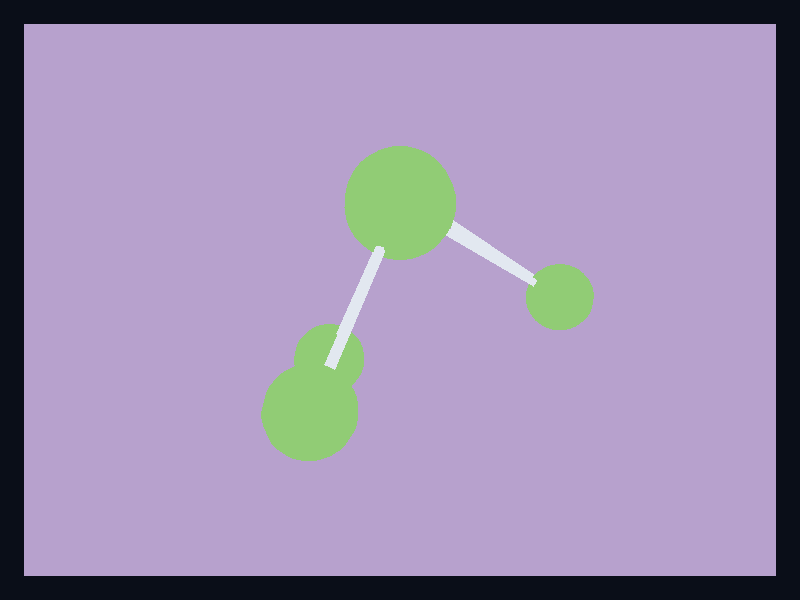
A network view has two authorities to keep separate: the devices and connections describe the network, whilst positions describe its layout. An edge referring to device router-a should continue to refer to that device after a layout change or a sort in the accompanying device list.
Do not use a device's current position in a vector as its durable identity. That turns an innocent reordering into a change in the displayed network.
Resolve endpoints before rendering
Use ordinary Rust to resolve connection IDs to positions. This operation is small and deterministic; it belongs with the data projection rather than inside a scene primitive.
use std::collections::HashMap;
use fission::three_d::Point3D;
use crate::widgets::spatial_graph::Link3D;

#[derive(Clone)]
pub struct NetworkDevice {
    pub id: String,
    pub position: Point3D,
}

pub struct DeviceConnection {
    pub from_id: String,
    pub to_id: String,
}

pub fn connection_geometry(
    devices: &[NetworkDevice],
    connections: &[DeviceConnection],
) -> Result<Vec<Link3D>, String> {
    let mut positions = HashMap::new();
    for device in devices {
        if positions.insert(device.id.as_str(), &device.position).is_some() {
            return Err(format!("duplicate device ID: {}", device.id));
        }
    }
    connections.iter().map(|connection| {
        let from = positions.get(connection.from_id.as_str())
            .ok_or_else(|| format!("unknown device: {}", connection.from_id))?;
        let to = positions.get(connection.to_id.as_str())
            .ok_or_else(|| format!("unknown device: {}", connection.to_id))?;
        Ok(Link3D {
            from: (**from).clone(),
            to: (**to).clone(),
        })
    }).collect()
}
Link3D and the NetworkScene Compose component are defined in 3D graph; put them in widgets/spatial_graph.rs. Pass the resolved links, device positions, translated title and theme colours to that component. Enable the three-d feature.
An unknown endpoint is an error, not a connection which may be silently omitted. Handle the result in the application's projection or loading flow and render a clear failure state if the graph cannot be represented correctly.
What the scene provides
fission::three_d::Scene3D stores Vec<Primitive3D> geometry. Spheres represent devices and prism meshes represent resolved links; optional width and height values size the viewport. This interface has no size, camera or ambient_light builders and does not provide graph layout, selection or per-device chart events automatically.
For a network with no meaningful spatial placement, a two-dimensional graph or labelled connection list is usually clearer. Depth can hide a device or link without changing the underlying network.
Checks
Test duplicate IDs, missing endpoints and input reordering. Then inspect a rendered network with representative density; valid geometry alone cannot prove that the connections are readable.
Keep device names, status and connection endpoints available in an accessible list or table. Colour and location are not sufficient identifiers. The screenshot above is a gallery fixture rather than output from this projection.
Tags: 3d, graph.
Previous
3D mesh field
Next
3D network scene