
Force graph
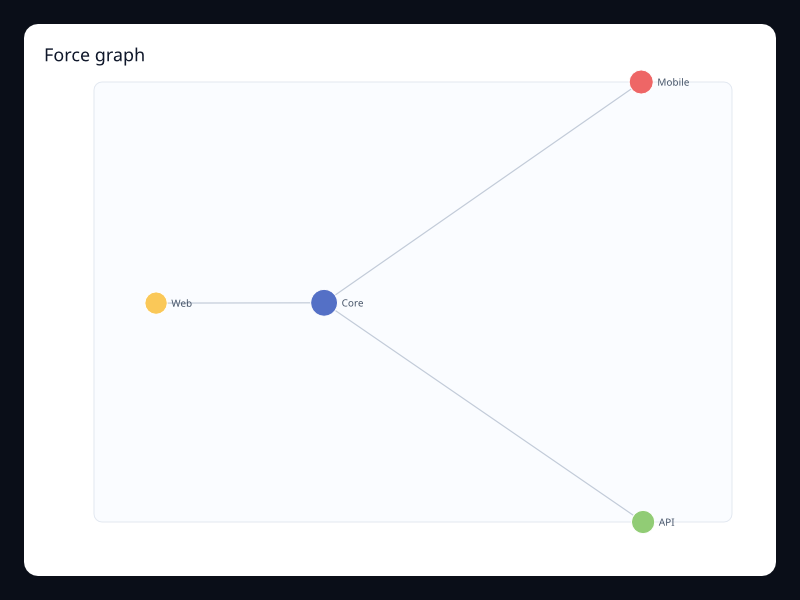
A graph is appropriate when the relationships themselves matter. A package dependency view, for example, needs to preserve which package depends on which other package, including dependencies shared by several callers. The screenshot is from Fission's chart gallery.
What the chart is for
Use stable package IDs and define source-to-target as dependent to dependency. The force layout positions nodes for display; distance is not version similarity, dependency strength or runtime latency.
Data model
GraphNode has id, display name and a numeric value affecting marker size. Use equal values for topology alone. GraphEdge contains source and target IDs; both must resolve to nodes in the same snapshot.
Authoring from a Fission component
The parent prepares the dependency graph and localized chart labels. Scanning packages belongs in an effect or report-preparation layer.
use fission::prelude::*;
use fission::charts::{Chart, GraphNode, GraphSeries};
use fission::charts::series::graph::GraphEdge;

// The parent resolves display labels from its translation bundles.
fission_component! {
    pub PackageDependencyGraph<()> {
        props {
            chart_title: String,
            series_label: String,
            packages: Vec<GraphNode>,
            dependencies: Vec<GraphEdge>,
        }
    }
    view(graph, _state, _cx) => Chart(
        title: Some(graph.chart_title.clone()),
        series: vec![GraphSeries::new(&graph.series_label)
            .nodes(graph.packages.clone())
            .edges(graph.dependencies.clone())
            .into()],
    )
}
Testing and accessibility
Test repeated package names with different IDs, missing endpoints and cycles. Provide a readable dependency list and inspect dense graphs for overlapping labels. Selecting a display index must not substitute for resolving a stable package identity.
Tags: graph, network.
Previous
Relationships and hierarchy
Next
Funnel