
Brush region
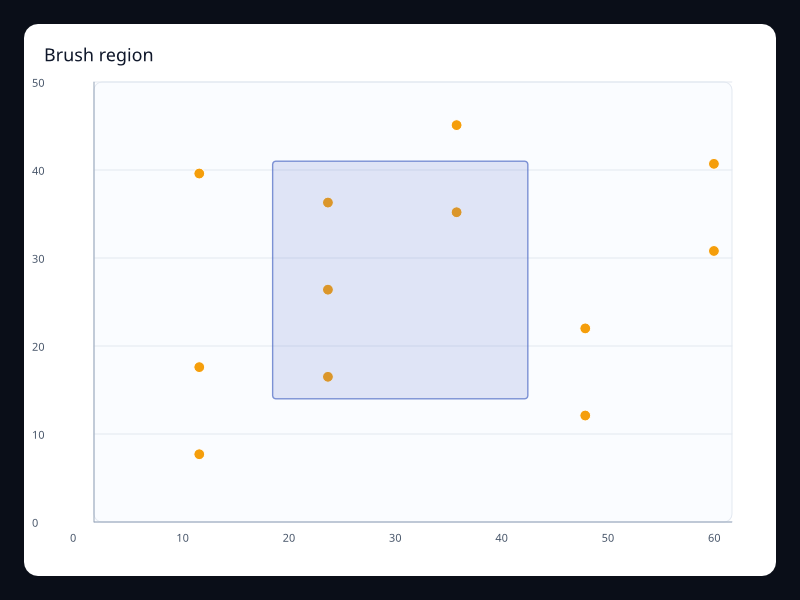
A region brush selects several observations in one action. This is useful when a user wants to inspect orders in a value and item-count range, rather than repeatedly opening individual points. The screenshot is from Fission's chart gallery.
What the chart is for
Here, x is basket value in GBP and y is item count. The chart stores the brush gesture, whilst the component records the number of selected samples when the drag ends. A selection is not a new filter on the source records until the application chooses to apply it.
Data model
ScatterSeries::data takes numeric (x, y) pairs. ChartBrush::rect() enables the gesture; a preview rectangle, when supplied, uses fractions of the plot rather than data coordinates. It shows an initial region, not the result of an analysis.
Rust API
Setting | Type | Meaning |
|---|---|---|
ChartInteraction::brush | ChartBrush | Enables a rectangular, horizontal or vertical brush. |
ChartBrush::preview_rect | Four f32 values | Sets an initial x, y, width and height in plot fractions. |
Chart::on_brush | ActionEnvelope | Handles the completed brush through the reducer flow. |
ChartBrushSelection::from_action_input | Decoder | Reads the brush region and matching items from reducer input. |
Example
use fission::charts::{Axis, Chart, ChartBrush, ChartInteraction, ScatterSeries};

let chart = Chart::new()
    .title("Orders by basket value and item count")
    .x_axis(Axis::value())
    .y_axis(Axis::value())
    .interaction(ChartInteraction::new().brush(ChartBrush::rect()))
    .series(vec![ScatterSeries::new("Orders")
        .data(vec![(24.0, 2.0), (58.0, 4.0), (91.0, 6.0), (146.0, 8.0)])
        .into()]);
Authoring from a Fission component
The chart owns the gesture. The component uses retained local state only for the selection summary, and reads the typed completion input in a generated reducer.
use fission::prelude::*;
use fission::charts::{
    Axis, Chart, ChartBrush, ChartBrushSelection, ChartInteraction, ScatterSeries,
};

// The parent resolves display labels from its translation bundles.
fission_component! {
    pub BrushRegionChart<()> {
        props {
            chart_title: String,
            series_label: String,
            summary_pattern: String, // Contains the {value} placeholder.
            samples: Vec<(f32, f32)>,
        }
        state { selected_count: usize = 0 }
    }
    view(selection, _state, cx) =>
        Column(
            children: [
                Chart(
                    key: "sample-brush",
                    title: Some(selection.chart_title.clone()),
                    x_axis: Some(Axis::value()),
                    y_axis: Some(Axis::value()),
                    interaction: ChartInteraction::new().brush(ChartBrush::rect()),
                    series: vec![ScatterSeries::new(&selection.series_label)
                        .data(selection.samples.clone())
                        .into()],
                    on_brush: reduce {
                        if let Some((_source, brushed)) =
                            ChartBrushSelection::from_action_input(&cx.input)
                        {
                            selection.selected_count = brushed.items.len();
                        }
                    },
                ),
                Text(
                    selection.summary_pattern.replace("{value}", &format!("{}", selection.selected_count)),
                ),
            ],
        )
}
Testing and accessibility
Test selection at plot boundaries, no matching points and a cleared selection. If the source changes during a drag, resolve the returned item indices against the correct current snapshot before applying a domain action.
Provide an equivalent list or numeric filters when users cannot drag a region. A pointer-only selection must not be the only route to the records being investigated.
Tags: brush, selection.
Previous
Brush outliers