
Access matrix
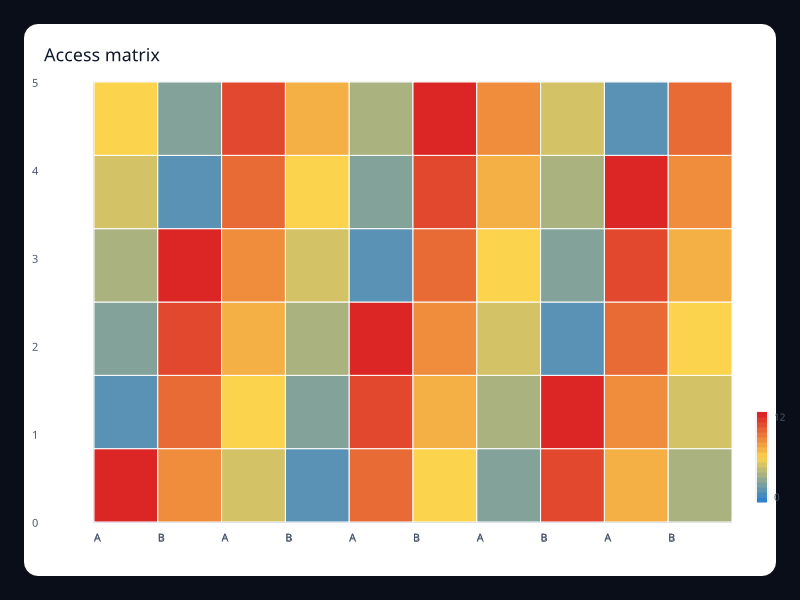
An access matrix lets an administrator compare effective permissions across roles and resources. The important word is effective: displaying a role's explicit grants alone can hide permissions inherited from another rule. The screenshot is from Fission's chart gallery.
What the chart is for
A matrix is useful for reviewing many decisions together, but a permission editor also needs named controls and readable allowed/denied states. Do not make a user infer a security decision from colour.
Data model
Each cell is a resource index, role index and access value: one for allowed, zero for denied. Resolve the actual policy before creating these samples. The chart displays the decision; it must never become the authority that grants access.
HeatmapSeries::data takes Vec<(usize, usize, f32)>. The first two values are category indices; they must refer to the same ordered labels used by the axes.
Rust API
Setting | Type | Meaning |
|---|---|---|
Chart::x_axis | Axis | Supplies the column categories. |
Chart::y_axis | Axis | Supplies the row categories, not the cell-value range. |
HeatmapSeries::data | Vec<(usize, usize, f32)> | Supplies the indexed cells and their values. |
Chart::visual_map | VisualMap | Sets the numeric range used for colour. |
Example
use fission::charts::{Axis, Chart, HeatmapSeries, VisualMap};

let chart = Chart::new()
    .title("Effective access by role and resource")
    .x_axis(Axis::category(vec!["Invoices", "Reports", "Users"]))
    .y_axis(Axis::category(vec!["Viewer", "Administrator"]))
    .visual_map(VisualMap::new().min(0.0).max(1.0))
    .series(vec![HeatmapSeries::new("Access allowed")
        .data(vec![
            (0, 0, 0.0),
            (1, 0, 1.0),
            (2, 0, 0.0),
            (0, 1, 1.0),
            (1, 1, 1.0),
            (2, 1, 1.0),
        ])
        .into()]);
Authoring from a Fission component
Pass the prepared samples into the component. Fetching, aggregation and failure handling stay outside the build; the component presents values already available to its parent.
use fission::prelude::*;
use fission::charts::{Axis, Chart, HeatmapSeries, VisualMap};

// The parent resolves display labels from its translation bundles.
fission_component! {
    pub AccessMatrixChart<()> {
        props {
            chart_title: String,
            series_label: String,
            column_labels: Vec<String>,
            row_labels: Vec<String>,
            samples: Vec<(usize, usize, f32)>,
        }
    }
    view(chart, _state, _cx) =>
        Chart(
            title: Some(chart.chart_title.clone()),
            x_axis: Some(Axis::category(
                chart.column_labels.iter().map(String::as_str).collect(),
            )),
            y_axis: Some(Axis::category(
                chart.row_labels.iter().map(String::as_str).collect(),
            )),
            visual_map: Some(VisualMap::new().min(0.0).max(1.0)),
            series: vec![HeatmapSeries::new(&chart.series_label)
                .data(chart.samples.clone())
                .into()],
        )
}
Testing and accessibility
Check inherited grants, explicit denials and a role with no access. Keep the index-to-role mapping stable when filtering; assigning the right value to the wrong role is more serious than a visual defect.
Give the matrix a text summary and an exact-value view when decisions depend on its cells. Inspect the actual rendered width and label lengths; a correctly indexed matrix is still unusable if its category names cannot be read.
Tags: heatmap, security.
Previous
Heatmap