
Migration routes
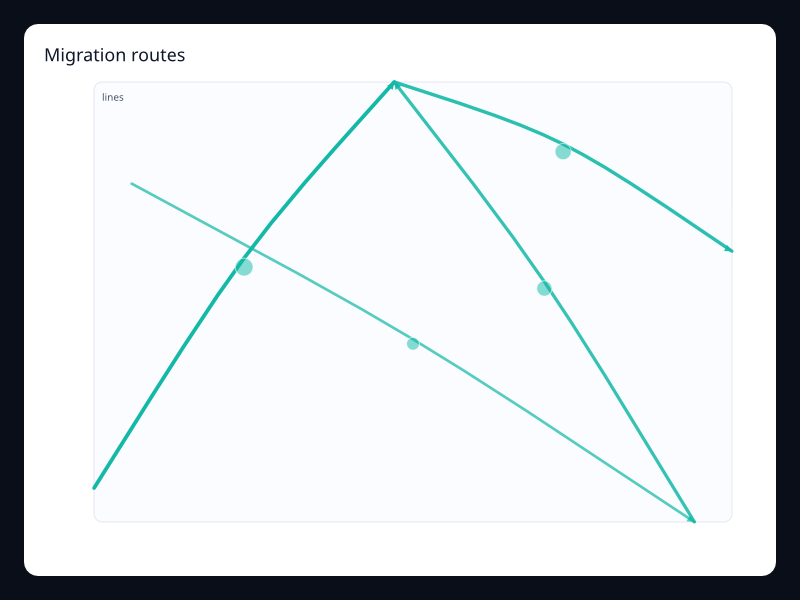
Movement between sites is a set of relationships, not a sequence of revenue samples. For a warehouse transfer report, each row needs an origin, a destination and the number of completed transfers in the reporting window.
Reuse ServiceConnection and the Compose component from lines, placed in widgets/service_connections.rs:
use crate::widgets::service_connections::ServiceConnection;

pub struct CompletedTransferRoute {
    pub id: String,
    pub origin: (f32, f32),
    pub destination: (f32, f32),
    pub completed_transfers: u32,
}

pub fn transfer_connections(routes: &[CompletedTransferRoute]) -> Vec<ServiceConnection> {
    routes.iter()
        .filter(|route| route.completed_transfers > 0)
        .map(|route| ServiceConnection {
            id: route.id.clone(),
            from: route.origin,
            to: route.destination,
            traffic: route.completed_transfers as f32,
        })
        .collect()
}
Pass this projection as the component's connections, with translated title, series label and explanatory text. Coordinates must be finite and share a coordinate system. The original counts and route IDs remain authoritative.
These curves communicate relative movement; their length is not road distance and their bend is not a recorded journey. The renderer fits the endpoint bounds itself, so this is a schematic, not a map overlay. Test reversed routes, zero transfers and coincident endpoints. State the reporting window near the exact-value list. The gallery screenshot uses separate records.
Previous
Geo network
Next
Region value map