
Stacked revenue dataset
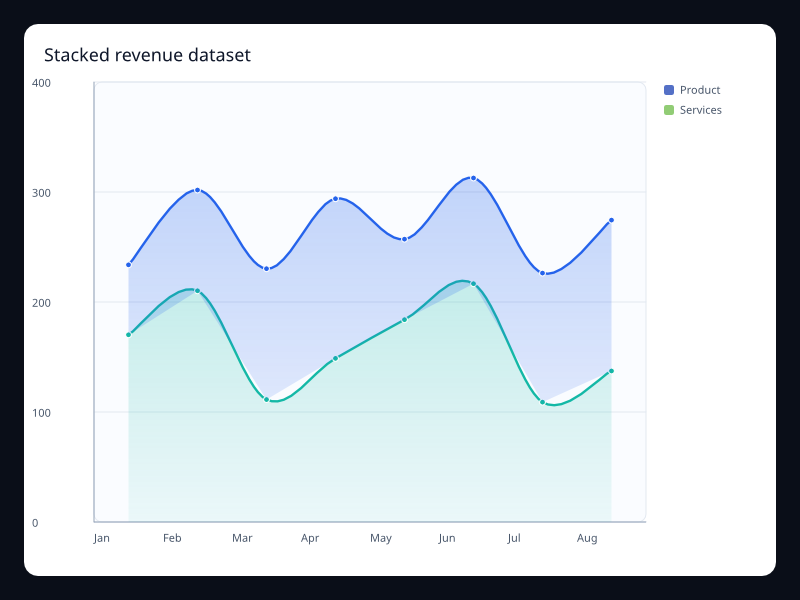
A revenue stack should explain a total. Direct and partner sales can be added when each sale belongs to one channel; recognised revenue and cash received cannot, because they describe overlapping events.
Use one row per reporting period and store money in minor units in the authoritative model:
use fission::charts::{BarSeries, DataValue, Dataset, Encode, Series};

pub fn revenue_projection(
    rows: &[(String, u64, u64)],
    direct_label: &str,
    partner_label: &str,
) -> (Dataset, Vec<Series>) {
    let dataset = Dataset::new()
        .dimensions(vec!["period".into(), "direct".into(), "partner".into()])
        .source(rows.iter().map(|(period, direct_minor, partner_minor)| vec![
            DataValue::from(period.clone()),
            DataValue::from(*direct_minor as f32 / 100.0),
            DataValue::from(*partner_minor as f32 / 100.0),
        ]).collect());
    let series = vec![
        Series::Bar(BarSeries::new(direct_label).stack("revenue")
            .encode(Encode::new().x("period").y("direct"))),
        Series::Bar(BarSeries::new(partner_label).stack("revenue")
            .encode(Encode::new().x("period").y("partner"))),
    ];
    (dataset, series)
}
Install these values on Chart.dataset and Chart.series in the encoded bars Compose pattern, with an empty category axis and a zero-based value axis. Translate the chart, currency-unit and channel labels; revenue is only the internal stack identifier.
This projection assumes a currency with 100 minor units per major unit and a single currency per report. Change that explicit rule for currencies with different units; never add amounts across currencies without a stated conversion policy. Floating-point chart coordinates are not an accounting ledger. Test the integer channel totals before projection, retain exact formatted amounts, and distinguish missing data from a period confirmed to have no sales. The gallery uses separate data.
Previous
Risk bubbles dataset