
Service graph
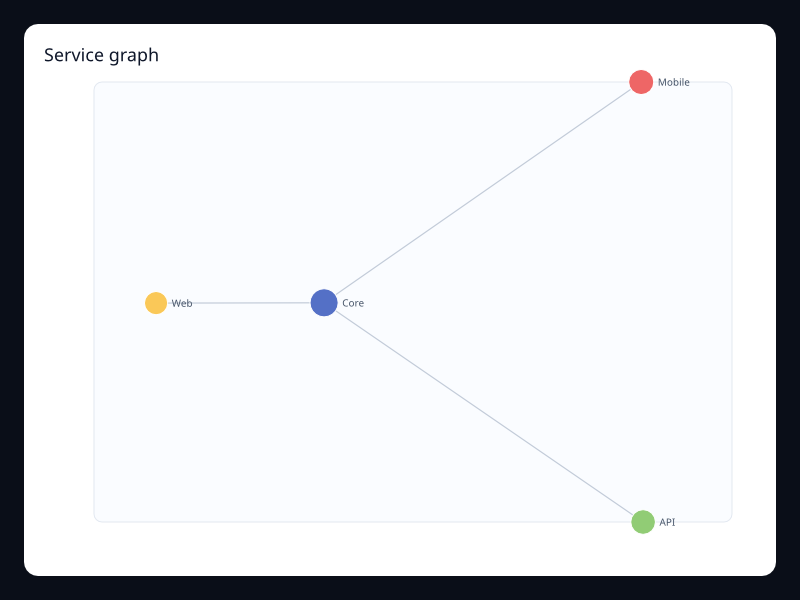
A service graph puts observed or declared calls in their system context. This helps explain which downstream service may be involved when a request through the gateway fails. The screenshot is from Fission's chart gallery.
What the chart is for
Decide whether the graph represents configured dependencies or calls observed during a time window. An absent observed edge might mean no traffic was recorded, not that a dependency is impossible. The example represents declared service calls.
Data model
Each service has a stable ID independent of its displayed name. Edges connect those IDs. Keep node values equal unless you also explain the measure represented by marker size; a larger circle must not silently mean higher request volume.
Rust API
Setting | Type | Meaning |
|---|---|---|
GraphSeries::nodes | Vec<GraphNode> | Supplies identified and named nodes. |
GraphSeries::edges | Vec<GraphEdge> | Connects source IDs to target IDs. |
Chart::series | Vec<Series> | Adds the relationship series without Cartesian axes. |
GraphEdge is imported from fission::charts::series::graph.
Example
use fission::charts::{Chart, GraphNode, GraphSeries};
use fission::charts::series::graph::GraphEdge;

let relationships = GraphSeries::new("Service calls")
    .nodes(vec![
        GraphNode {
            id: "gateway".into(),
            name: "Gateway".into(),
            value: 1.0,
        },
        GraphNode {
            id: "catalog".into(),
            name: "Catalog".into(),
            value: 1.0,
        },
        GraphNode {
            id: "payments".into(),
            name: "Payments".into(),
            value: 1.0,
        },
    ])
    .edges(vec![
        GraphEdge {
            source: "gateway".into(),
            target: "catalog".into(),
        },
        GraphEdge {
            source: "gateway".into(),
            target: "payments".into(),
        },
    ]);

let chart = Chart::new()
    .title("Calls between application services")
    .series(vec![relationships.into()]);
Authoring from a Fission component
Prepare the records outside the build, then pass them as props. The component does not discover services or run network requests while constructing the chart.
use fission::prelude::*;
use fission::charts::{Chart, GraphNode, GraphSeries};
use fission::charts::series::graph::GraphEdge;

// The parent resolves display labels from its translation bundles.
fission_component! {
    pub ServiceGraphChart<()> {
        props {
            chart_title: String,
            series_label: String,
            nodes: Vec<GraphNode>,
            edges: Vec<GraphEdge>,
        }
    }
    view(graph, _state, _cx) =>
        Chart(
            title: Some(graph.chart_title.clone()),
            series: vec![GraphSeries::new(&graph.series_label)
                .nodes(graph.nodes.clone())
                .edges(graph.edges.clone())
                .into()],
        )
}
Testing and accessibility
Check renamed services, missing endpoints and a temporarily disconnected service. If using observed calls, show the observation window and telemetry gaps outside the chart.
Give users a readable list of connections as well as the visual. If selecting a node opens details, dispatch that selection through a reducer and resolve it against the current records.
Tags: graph, service.
Previous
Revenue sunburst
Next
Storage treemap