
Timeline releases
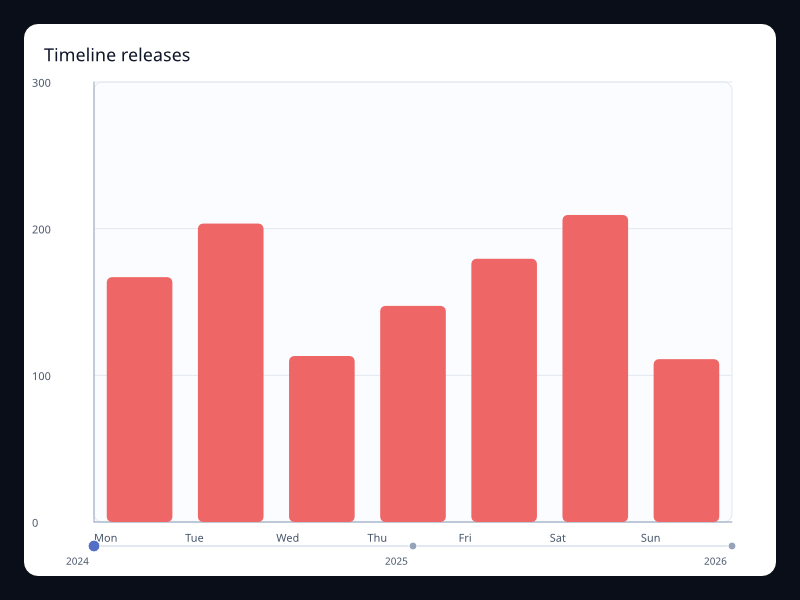
A release comparison needs an actual selected dataset, not only a highlighted timeline label. Fission's current ChartTimeline paints that indicator; it does not switch series or implement automatic playback from play_interval_ms.
Use normal controls and retained component state to choose a snapshot. The same selected index supplies both the data and the timeline marker.
use fission::prelude::*;
use fission::charts::{Axis, BarSeries, Chart, ChartTimeline, Series};

#[derive(Clone, serde::Serialize, serde::Deserialize)]
pub struct ReportSnapshot {
    pub step_label: String,
    pub title: String,
    pub categories: Vec<String>,
    pub counts: Vec<u32>,
}

fission_component! {
    pub SnapshotBrowser<()> {
        props {
            heading: TextContent,
            previous_label: TextContent,
            next_label: TextContent,
            empty_label: TextContent,
            measure_label: String,
            snapshots: Vec<ReportSnapshot>,
        }
        state { current: usize = 0 }
    }
    view(browser, _state, _cx) {
        let last = browser.snapshots.len().saturating_sub(1);
        let index = browser.current.min(last);
        let frame = browser.snapshots.get(index);
        let steps: Vec<String> = browser.snapshots.iter()
            .map(|snapshot| snapshot.step_label.clone()).collect();
    } => Column(children: [
        Text(browser.heading.clone()),
        Row(children: [
            Button(
                child: Text(browser.previous_label.clone()),
                disabled: index == 0,
                on_press: reduce {
                    let last = browser.snapshots.len().saturating_sub(1);
                    browser.current = browser.current.min(last).saturating_sub(1);
                },
            ),
            Button(
                child: Text(browser.next_label.clone()),
                disabled: frame.is_none() || index == last,
                on_press: reduce {
                    let last = browser.snapshots.len().saturating_sub(1);
                    browser.current = browser.current.saturating_add(1).min(last);
                },
            ),
        ]),
        if let Some(snapshot) = frame {
            Chart(
                key: "snapshot-report",
                title: Some(snapshot.title.clone()),
                x_axis: Some(Axis::category(
                    snapshot.categories.iter().map(String::as_str).collect(),
                )),
                y_axis: Some(Axis::value().min(0.0)),
                timeline: Some(ChartTimeline::new(steps).current_index(index)),
                series: vec![Series::Bar(
                    BarSeries::new(&browser.measure_label)
                        .data(snapshot.counts.iter().map(|count| *count as f32).collect()),
                )],
            )
        } else {
            Text(browser.empty_label.clone())
        },
    ])
}
Put both definitions in widgets/snapshot_browser.rs. For release analysis, each snapshot might contain queue counts from the same stage of an equivalent load test. Translate all display labels in the parent and validate category/count alignment.
This local index is presentation memory, not the identity of a release. Use stable release IDs in the source model, and move selection to application state if other screens must share it. Test empty data, the first/last frame and a shrinking snapshot list. Use LiveTest to confirm the buttons change both values and indicator. The gallery screenshot does not demonstrate playback.
Previous
Timeline
Next
Timeline years