
Platform topology graph
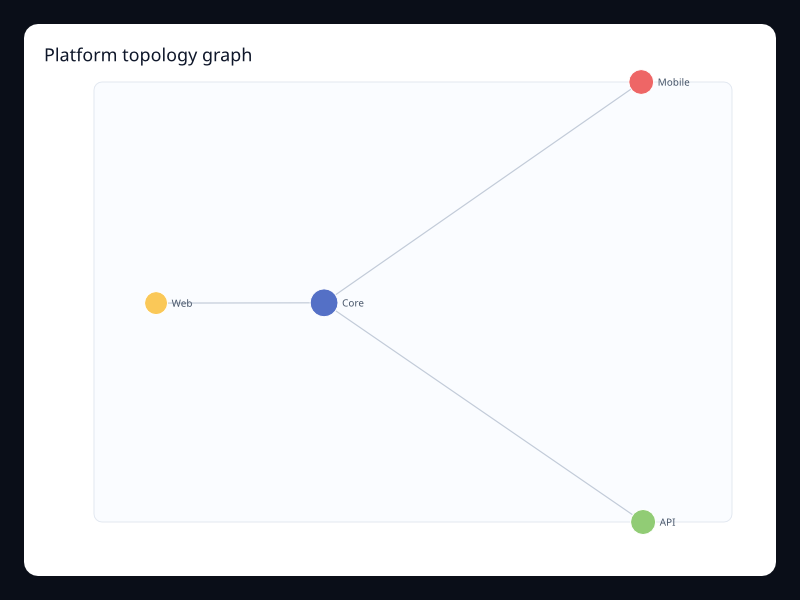
A topology graph explains which platform components connect. This is useful during an operational review because a component's position in the request path matters as much as its individual status. The screenshot is from Fission's chart gallery.
What the chart is for
Here, connections are declared relationships between ingress, the API and the database. A declared connection does not mean it is currently healthy. Show health with an explicit status model rather than assuming topology is a live availability check.
Data model
Give each deployed component a stable ID and resolve every edge against that node set. Equal node values keep circle size from suggesting capacity or request volume without a defined measure.
Rust API
Setting | Type | Meaning |
|---|---|---|
GraphSeries::nodes | Vec<GraphNode> | Supplies stable IDs and readable labels. |
GraphSeries::edges | Vec<GraphEdge> | Connects source and target IDs. |
Chart::series | Vec<Series> | Presents the relationship series without Cartesian axes. |
Example
use fission::charts::{Chart, GraphNode, GraphSeries};
use fission::charts::series::graph::GraphEdge;

let routes = GraphSeries::new("Connections")
    .nodes(vec![
        GraphNode {
            id: "ingress".into(),
            name: "Ingress".into(),
            value: 1.0,
        },
        GraphNode {
            id: "api".into(),
            name: "API".into(),
            value: 1.0,
        },
        GraphNode {
            id: "database".into(),
            name: "Database".into(),
            value: 1.0,
        },
    ])
    .edges(vec![
        GraphEdge {
            source: "ingress".into(),
            target: "api".into(),
        },
        GraphEdge {
            source: "api".into(),
            target: "database".into(),
        },
    ]);

let chart = Chart::new()
    .title("Platform component topology")
    .series(vec![routes.into()]);
Authoring from a Fission component
Prepare the records before building the chart, then pass them into a presentation component. Loading and failure states belong to the parent workflow rather than an implicit request made during a build.
use fission::prelude::*;
use fission::charts::{Chart, GraphNode, GraphSeries};
use fission::charts::series::graph::GraphEdge;

// The parent resolves display labels from its translation bundles.
fission_component! {
    pub PlatformTopologyGraphChart<()> {
        props {
            chart_title: String,
            series_label: String,
            nodes: Vec<GraphNode>,
            edges: Vec<GraphEdge>,
        }
    }
    view(graph, _state, _cx) =>
        Chart(
            title: Some(graph.chart_title.clone()),
            series: vec![GraphSeries::new(&graph.series_label)
                .nodes(graph.nodes.clone())
                .edges(graph.edges.clone())
                .into()],
        )
}
Testing and accessibility
Test removed components and partially discovered topologies. Preserve the distinction between an empty system and a failed discovery operation before constructing the chart.
Provide a readable connection list as an alternative to tracing lines. If a selection opens details, dispatch it through a reducer and identify the record by its current stable ID.
Tags: graph, platform.
Previous
Platform module tree