
Recruiting funnel
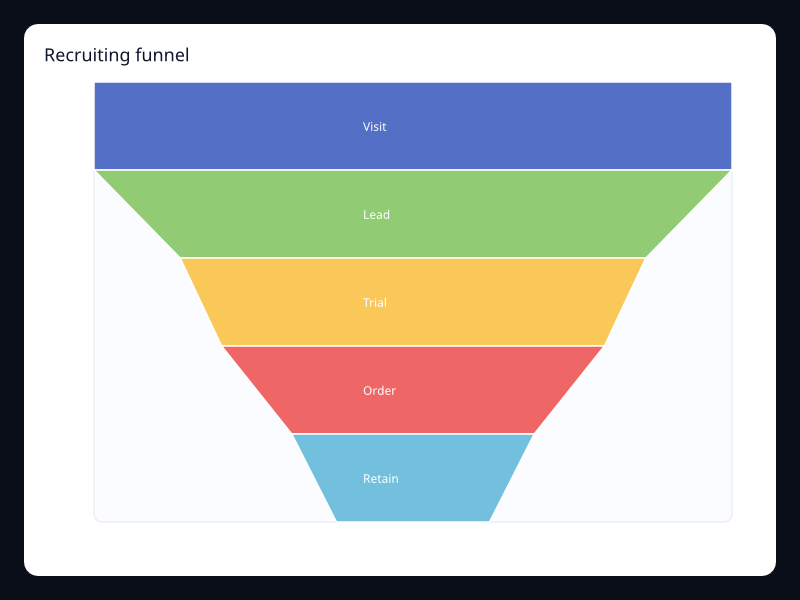
A recruiting funnel follows candidates through a particular hiring process. Mixing applications for several roles can hide different requirements and stages behind one apparently consistent shape. The screenshot is from Fission's chart gallery.
What the chart is for
Use one role or a deliberately comparable role group and one application cohort. A candidate who has not yet reached an interview is not necessarily a rejection, particularly while the hiring process remains open.
Data model
Supply ordered non-negative counts of candidates who reached each stage. FunnelSeries preserves input order; it does not model candidate status, calculate time-to-hire or infer reasons for drop-off.
Authoring from a Fission component
The parent aggregates application records with privacy-appropriate reporting and localized stage labels.
use fission::prelude::*;
use fission::charts::{Chart, FunnelSeries};

// The parent resolves display labels from its translation bundles.
fission_component! {
    pub RoleCandidateFunnel<()> {
        props {
            chart_title: String,
            series_label: String,
            candidates_by_stage: Vec<(String, f32)>,
        }
    }
    view(report, _state, _cx) {
        let values = report.candidates_by_stage.iter()
            .map(|(label, value)| (label.as_str(), *value))
            .collect();
    } => Chart(
        title: Some(report.chart_title.clone()),
        series: vec![FunnelSeries::new(&report.series_label)
            .data(values)
            .into()],
    )
}
Testing and accessibility
Test withdrawn candidates, repeated applications and pending decisions. State the cohort date and provide exact counts; avoid publishing small groups or labels which identify individual candidates.
Tags: funnel, pipeline.
Previous
Quality parallel coordinates