
Org tree
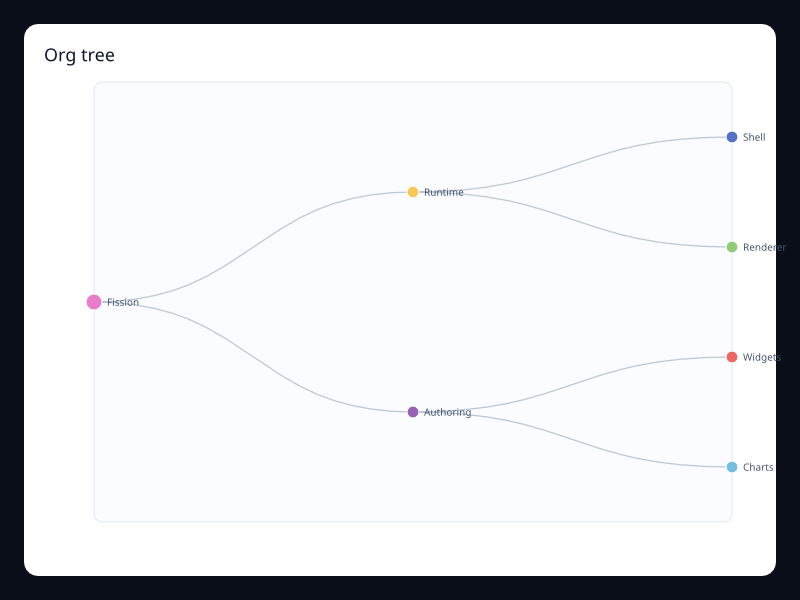
An organisation tree explains reporting relationships by preserving the parent of each team. It is useful when a reader needs to find where a team belongs, not just how many teams exist. The screenshot is from Fission's chart gallery.
What the chart is for
A tree gives each child one parent. That is appropriate for a reporting line, but not for every form of ownership or collaboration. Use a graph if a team genuinely has several relationships that must be shown together.
Data model
Supply nested TreemapNode records to TreeSeries. The values are structural placeholders here, not headcounts; the relationship comes from the children field. Keep headcount as a separately named measure if the report needs it.
Rust API
Setting | Type | Meaning |
|---|---|---|
TreeSeries::data | Vec<TreemapNode> | Supplies the root nodes and their nested children. |
TreemapNode::children | Vec<TreemapNode> | Describes the next level of the hierarchy. |
TreemapNode::value | f32 | Carries the node's numeric measure. |
Chart::series | Vec<Series> | Adds this hierarchy without Cartesian axes. |
Example
use fission::charts::{Chart, TreeSeries, TreemapNode};

let nodes = vec![TreemapNode {
    name: "Product".into(),
    value: 2.0,
    children: vec![
        TreemapNode {
            name: "Engineering".into(),
            value: 1.0,
            children: vec![],
        },
        TreemapNode {
            name: "Design".into(),
            value: 1.0,
            children: vec![],
        },
    ],
}];

let chart = Chart::new()
    .title("Product team reporting structure")
    .series(vec![TreeSeries::new("Reporting lines")
        .data(nodes)
        .radial(false)
        .into()]);
Authoring from a Fission component
The parent supplies the prepared hierarchy. Keep loading, aggregation and any errors outside this presentation component.
use fission::prelude::*;
use fission::charts::{Chart, TreeSeries, TreemapNode};

// The parent resolves display labels from its translation bundles.
fission_component! {
    pub OrgTreeChart<()> {
        props {
            chart_title: String,
            series_label: String,
            nodes: Vec<TreemapNode>,
        }
    }
    view(hierarchy, _state, _cx) =>
        Chart(
            title: Some(hierarchy.chart_title.clone()),
            series: vec![TreeSeries::new(&hierarchy.series_label)
                .data(hierarchy.nodes.clone())
                .radial(false)
                .into()],
        )
}
Testing and accessibility
Check reorganisations, empty teams and repeated team names. Give readers a text version of the reporting hierarchy, and avoid treating visual distance between branches as an organisational distinction.
Tags: tree, hierarchy.
Previous
File-system tree
Next
Product sunburst