
Incident calendar
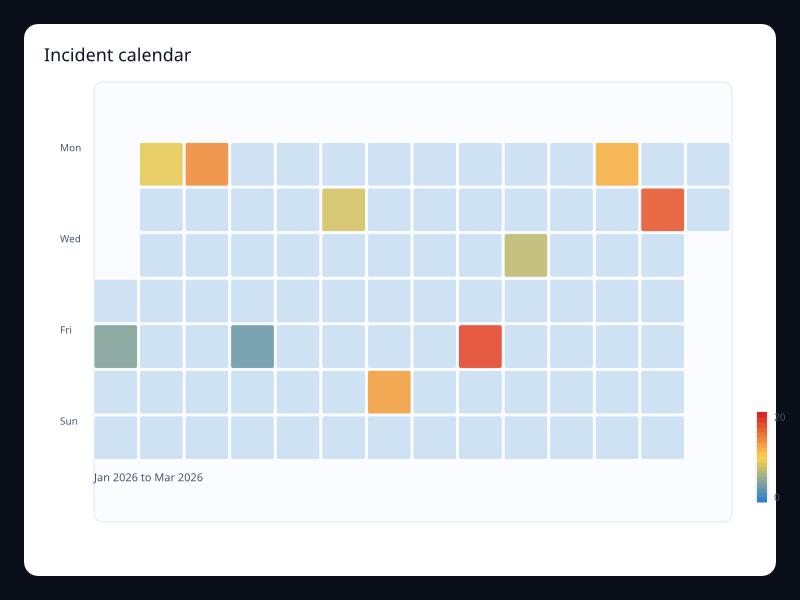
An incident calendar needs a rule for which date owns an incident. Counting the start date shows when new incidents arose; counting every day an incident remained open shows a different measure.
Use the actual CalendarHeatmapSeries composition in build calendars, adapting its typed daily record to incident counts. Aggregate start timestamps once in the reporting timezone, then supply one confirmed total for each date in the range.
use std::collections::BTreeMap;

pub fn incident_start_totals(reporting_dates: &[String]) -> BTreeMap<String, u32> {
    let mut totals = BTreeMap::new();
    for date in reporting_dates {
        *totals.entry(date.clone()).or_insert(0) += 1;
    }
    totals
}
The input here is already-normalised dates from validated incident records, not raw timestamps. Deduplicate incident IDs before counting retries or repeated events. Fill confirmed no-incident dates from a complete source, not from failed fetches.
Missing calendar values render as zero, so completeness is an application guarantee rather than a renderer check. Supply translated captions naming the date rule and window, and keep severity and unresolved status in an accessible incident list. Fixed English weekday captions remain a renderer limit.
Test an incident spanning midnight, repeated delivery of the same record, an empty complete window and an unavailable day. Volume is not a reliability rate without a service exposure denominator. The gallery uses separate inputs.
Previous
Correlation heatmap