
Radar profile A
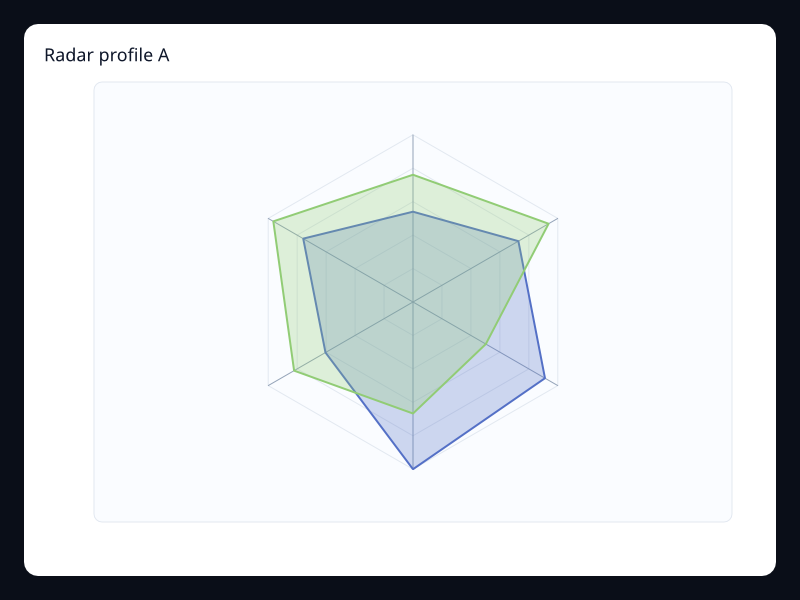
A capability profile can summarise several assessments without pretending they are one quantity. For a supplier review, delivery, support, quality and continuity can be shown together only after their scoring scales have been defined. The screenshot is from Fission's chart gallery.
What the chart is for
Use a common 0–100 scale with the same direction on every spoke, such as higher meaning better assessed capability. The chart does not make subjective scores objective or establish that a supplier with a larger polygon is the better choice.
Data model
RadarSeries::data stores Vec<Vec<f32>>. The first row sets the number of spokes and each value is mapped to a fixed 0–100 radius. The renderer does not supply named spoke labels; keep the dimension order and exact values in surrounding content.
Authoring from a Fission component
A fixed-length array makes the four-score requirement explicit. The parent supplies localized title, series name and dimension explanation, and retains the evidence used to assign each score.
use fission::prelude::*;
use fission::charts::{Chart, RadarSeries};

// The parent resolves display labels from its translation bundles.
fission_component! {
    pub SupplierCapabilityProfile<()> {
        props {
            chart_title: String,
            series_label: String,
            scores: [f32; 4],
            dimension_description: TextContent,
        }
    }
    view(supplier, _state, _cx) => Column(children: [
        Text(supplier.dimension_description.clone()),
        Chart(
            title: Some(supplier.chart_title.clone()),
            series: vec![RadarSeries::new(&supplier.series_label)
                .data(vec![supplier.scores.to_vec()])
                .into()],
        ),
    ])
}
Testing and accessibility
Test invalid scores, unavailable assessments and dimension-order changes. Do not replace an unassessed capability with zero unless the policy explicitly treats absence that way. Provide the four named scores and their evidence as an accessible table.
Tags: radar, profile.
Previous
Presentation rose
Next
Radar profile B