
Dynamic speed gauge
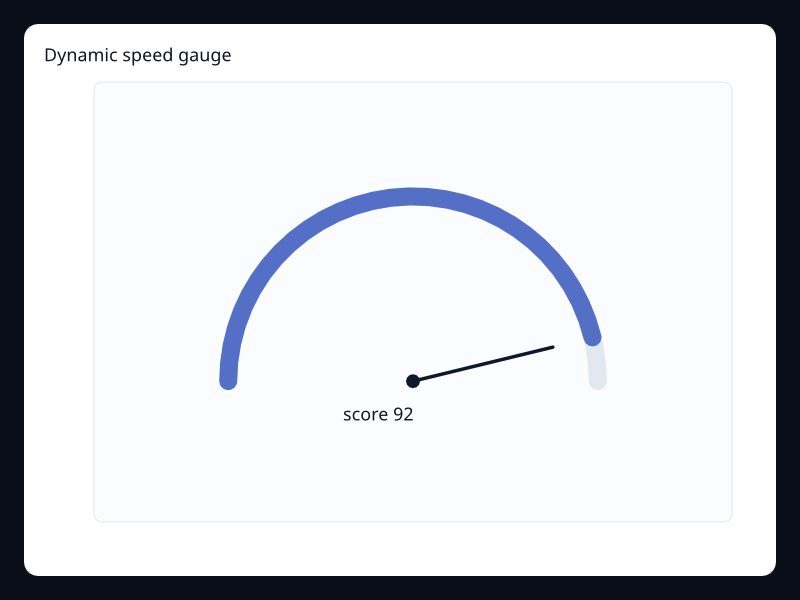
The current gauge has a fixed 0–100 dial, so it is not a configurable physical speedometer. Passing kilometres per hour directly would silently give one hundred a special meaning regardless of the real limit.
One truthful alternative is a limit-utilisation gauge, accompanied by the actual speed and an explicit over-limit state.
use fission::prelude::*;
use fission::charts::{Chart, GaugeSeries, Series};

fission_component! {
    pub SpeedLimitUtilisation<()> {
        props {
            title: String,
            percent_label: String,
            reading_summary: TextContent,
            over_limit_label: TextContent,
            speed: f32,
            limit: f32,
        }
    }
    view(reading, _state, _cx) {
        let percent = reading.speed / reading.limit * 100.0;
    } => Column(children: [
        Text(reading.reading_summary.clone()),
        if percent > 100.0 {
            Text(reading.over_limit_label.clone())
        },
        Chart(
            title: Some(reading.title.clone()),
            series: vec![Series::Gauge(
                GaugeSeries::new(&reading.percent_label)
                    .data(vec![(reading.percent_label.as_str(), percent.min(100.0))]),
            )],
        ),
    ])
}
Validate finite non-negative speed, a finite positive limit and a finite calculated percentage before constructing the component. Use one speed unit for both inputs. The translated summary must include the actual uncapped speed and limit; the gauge deliberately caps only its completion presentation.
Do not present a full dial as proof that the speed equals the limit: an over-limit reading also fills it and must retain its warning. Test below, at and above the limit, missing readings and changes of unit. The screenshot uses a separate gallery fixture.
Previous
Dynamic single-axis events