
Dependency graph
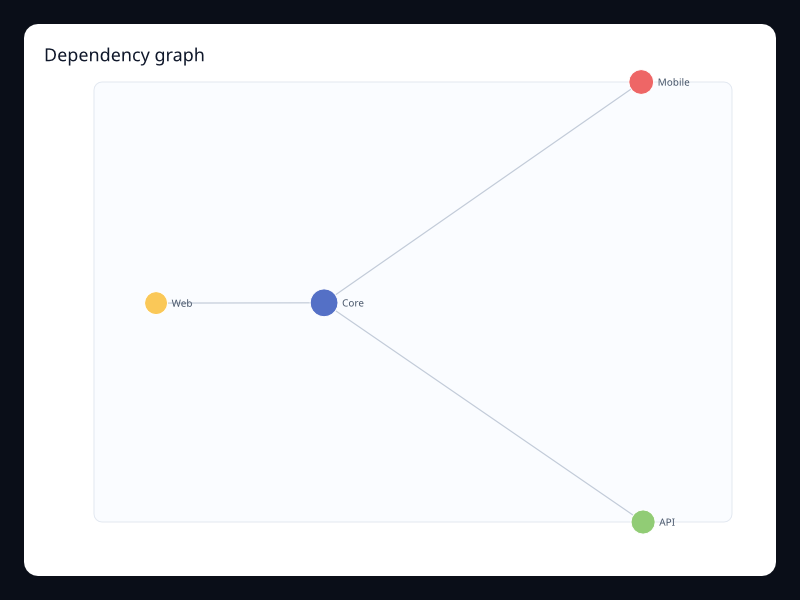
A dependency graph shows which parts of a project rely on which others. Unlike a tree, it can represent a shared dependency without making a separate copy for every consumer. The screenshot is from Fission's chart gallery.
What the chart is for
Here, an edge's source depends on its target: the application depends on shared widgets and the domain core. State that convention explicitly; reversing it produces a graph that still looks plausible but answers the opposite question.
Data model
Use durable IDs for build targets and readable names for labels. GraphEdge stores a source and target ID. Node values affect marker size, so the example keeps them equal rather than using an unexplained weight.
Rust API
Setting | Type | Meaning |
|---|---|---|
GraphSeries::nodes | Vec<GraphNode> | Supplies identified and named nodes. |
GraphSeries::edges | Vec<GraphEdge> | Connects source IDs to target IDs. |
Chart::series | Vec<Series> | Adds the relationship series without Cartesian axes. |
GraphEdge is imported from fission::charts::series::graph.
Example
use fission::charts::{Chart, GraphNode, GraphSeries};
use fission::charts::series::graph::GraphEdge;

let relationships = GraphSeries::new("Dependencies")
    .nodes(vec![
        GraphNode {
            id: "app".into(),
            name: "Application".into(),
            value: 1.0,
        },
        GraphNode {
            id: "widgets".into(),
            name: "Shared widgets".into(),
            value: 1.0,
        },
        GraphNode {
            id: "core".into(),
            name: "Domain core".into(),
            value: 1.0,
        },
    ])
    .edges(vec![
        GraphEdge {
            source: "app".into(),
            target: "widgets".into(),
        },
        GraphEdge {
            source: "app".into(),
            target: "core".into(),
        },
        GraphEdge {
            source: "widgets".into(),
            target: "core".into(),
        },
    ]);

let chart = Chart::new()
    .title("Build target dependencies")
    .series(vec![relationships.into()]);
Authoring from a Fission component
Prepare the records outside the build, then pass them as props. The component does not discover services or run network requests while constructing the chart.
use fission::prelude::*;
use fission::charts::{Chart, GraphNode, GraphSeries};
use fission::charts::series::graph::GraphEdge;

// The parent resolves display labels from its translation bundles.
fission_component! {
    pub DependencyGraphChart<()> {
        props {
            chart_title: String,
            series_label: String,
            nodes: Vec<GraphNode>,
            edges: Vec<GraphEdge>,
        }
    }
    view(graph, _state, _cx) =>
        Chart(
            title: Some(graph.chart_title.clone()),
            series: vec![GraphSeries::new(&graph.series_label)
                .nodes(graph.nodes.clone())
                .edges(graph.edges.clone())
                .into()],
        )
}
Testing and accessibility
Test endpoint resolution and shared dependencies. A graph can contain a cycle, but drawing it does not validate that the build system accepts it; keep dependency validation in the domain layer.
Give users a readable list of connections as well as the visual. If selecting a node opens details, dispatch that selection through a reducer and resolve it against the current records.
Tags: graph, network.
Previous
Demand theme river
Next
Energy sankey