
3D line path
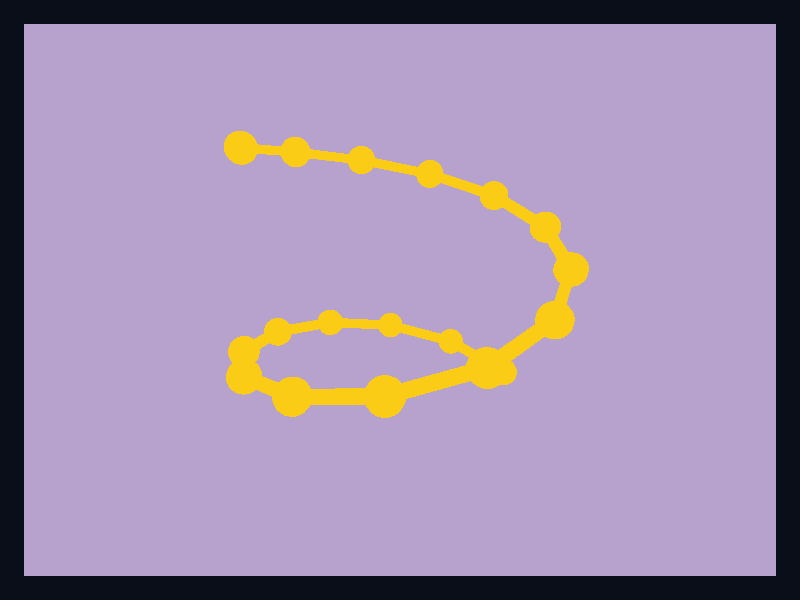
A path represents an order of movement, not merely a collection of positions. For an inspection route, joining samples after sorting by their X coordinate would create a different route from the one recorded.
This gallery entry uses the same sphere samples and segment meshes described in 3D line. It is not a separate line-series API.
Compose the continuous sections
Put InspectionTrajectory in widgets/inspection_trajectory.rs, using the segment_prism helper from 3D graph. Supply its sections from validated, ordered observations; 3D trajectory shows how to split timestamped observations at missing samples and excessive gaps.
use fission::prelude::*;
use fission::core::op::Color;
use fission::three_d::Point3D;
use crate::widgets::inspection_trajectory::InspectionTrajectory;

fission_component! {
    pub RecordedInspectionRoute<()> {
        props {
            title: TextContent,
            continuous_sections: Vec<Vec<Point3D>>,
            route_color: Color,
        }
    }
    view(recording, _state, _cx) => InspectionTrajectory {
        title: recording.title.clone(),
        sections: recording.continuous_sections.clone(),
        route_color: recording.route_color,
    }
}
Enable the three-d feature. The parent supplies translated text and a design-system colour. Keep sample timestamps and route identifiers in the source model; the point vectors only supply the geometry.
Checks
Test that missing sections remain disconnected and that a one-point section does not imply a movement segment. Provide direction, units and route duration outside the image rather than assuming that a line communicates them.
The scene does not emit per-sample chart events. Use a sample list or a picking-capable scene interface if inspection of individual observations is required. Inspect the rendered route where segments overlap; the screenshot is a gallery fixture.
Tags: 3d, line.
Previous
3D line
Next
3D mesh field