
3D response surface
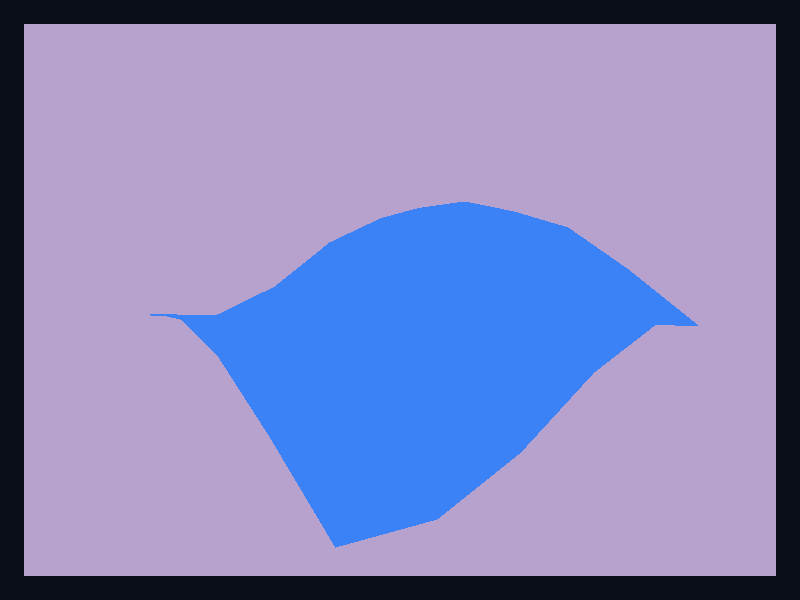
A response surface maps two inputs to one outcome. For an equipment test, those inputs might be load and operating setting, with measured response represented by height. A continuous surface is useful only when the interpolation between samples is justified.
Do not replace a missing experiment with a zero response. That can create a false valley and suggest that the setting was tested successfully.
Compose the validated surface
The Mesh surface reference defines SurveySurface, a geometry component which also works for a response field. Put it in widgets/survey_surface.rs. The analytics model owns scaling, vertex generation and triangle connectivity.
use fission::prelude::*;
use fission::core::op::Color;
use fission::three_d::Point3D;
use crate::widgets::survey_surface::SurveySurface;

fission_component! {
    pub EquipmentResponseSurface<()> {
        props {
            title: TextContent,
            response_vertices: Vec<Point3D>,
            triangle_indices: Vec<u32>,
            surface_color: Color,
        }
    }
    view(response, _state, _cx) => SurveySurface {
        title: response.title.clone(),
        vertices: response.response_vertices.clone(),
        indices: response.triangle_indices.clone(),
        surface_color: response.surface_color,
    }
}
Enable the three-d feature. Keep both input settings and response measurements in their original units in the source model. Explain any display normalisation or vertical exaggeration in accessible text alongside a source-value table.
Checks
Validate finite positions, valid triangle indices and the interpolation policy. Test a small known grid, missing experiments and changes to the coordinate scale. Then inspect a real rendering for holes and misleading slopes.
This is a mesh in fission::three_d::Scene3D, not a dedicated response-series API with inferred axes, camera builders or per-sample chart events. The gallery screenshot uses sample geometry.
Tags: 3d, surface.
Previous
3D outlier scatter
Next
3D risk terrain