
Radial and polar
The Radial and polar family contains 9 renderer-backed chart variants. Use this page as the entry point for choosing the right variant, then open the variant page for the screenshot, data shape, Rust API notes, and example code.
The chart family is still ordinary Fission UI. Each variant is constructed from typed Rust data, participates in layout and theme decisions, and can be driven by app state, reducers, resources, jobs, or services just like any other widget.
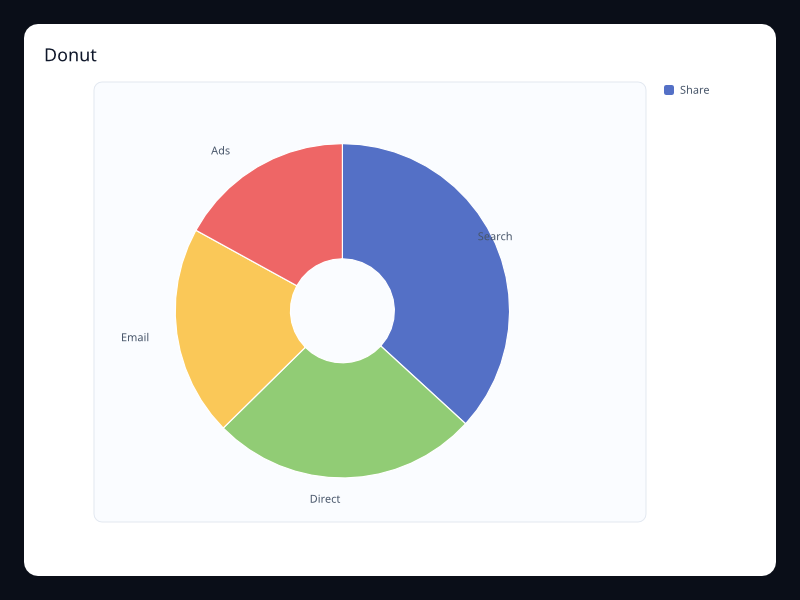
Variants
Chart | Data shape | Use when |
|---|---|---|
Label/value pairs plus inner radius. | Use it when the whole needs a central value or status. | |
Metric profiles plus fill style. | Use it when profile area and overlap should be visible. | |
One label/value pair with an expected range. | Use it when the value is read as a current instrument state. | |
One or more percentages. | Use it for capacity, completion, or quota states. | |
Label/value pairs. | Use it for a small number of categories where the whole matters. | |
One or more bounded values. | Use it for operational progress and service health panels. | |
Vec<Vec<f32>> where each row is one profile. | Use it for profile comparison across a fixed set of dimensions. | |
Label/value pairs plus area rose mode. | Use it when rose slices should emphasize difference without making small values disappear. | |
Label/value pairs plus radius rose mode. | Use it for presentation-heavy part-to-whole views. |
Choosing within this family
Start with the user's question, not the visual effect. Pick the simplest variant that makes the answer clear, add interaction only when it reduces work for the user, and keep animation purposeful enough that it explains a change rather than decorating the page.
Authoring from a Fission component
Use this reference page as the chart expression inside ordinary Fission component conversion. The chart is a Widget, so it can sit inside a Card, Grid, Scroll, responsive page section, or any other layout container.
use fission::prelude::*;
use fission::charts::{Axis, Chart, LineSeries};

pub struct RadialAndPolarChart;

impl From<RadialAndPolarChart> for Widget {
    fn from(_: RadialAndPolarChart) -> Widget {
        Chart::new()
            .title("Radial and polar")
            .x_axis(Axis::category(vec!["A", "B", "C"]))
            .y_axis(Axis::value())
            .series(vec![LineSeries::new("Series").data(vec![1.0, 2.0, 3.0]).into()])
            .into()
    }
}
Keep expensive data loading outside component conversion. A reducer, job, service, or server route should prepare the typed chart data, then the component should read that state and construct the chart deterministically.
Options, accessibility, and diagnostics
Area | What to decide | How to verify |
|---|---|---|
Data shape | Keep source rows in typed Rust structs, then map them into the series type shown in the example. | Unit test the mapping separately from rendering. |
Options | Choose axes, legends, labels, animation, and interaction based on the user's task. | Add a screenshot test when changing visual behavior. |
Accessibility | Provide a clear title and adjacent summary text for important trends or outliers. | Inspect the generated semantics and make sure the chart is understandable without color alone. |
Failure handling | Render an empty, loading, or error state before constructing the chart if data is unavailable. | Test empty data, partial data, and failed fetches. |
Performance | Prefer summarized or windowed data for very large datasets; keep full raw history in the data layer. | Profile frame time and interaction latency with representative data volumes. |
Previous
Wind speed polar line
Next
Donut